
NCDEX RAINMUMBAI lists 29 May, opens weather as an Indian asset class
Yobee Team
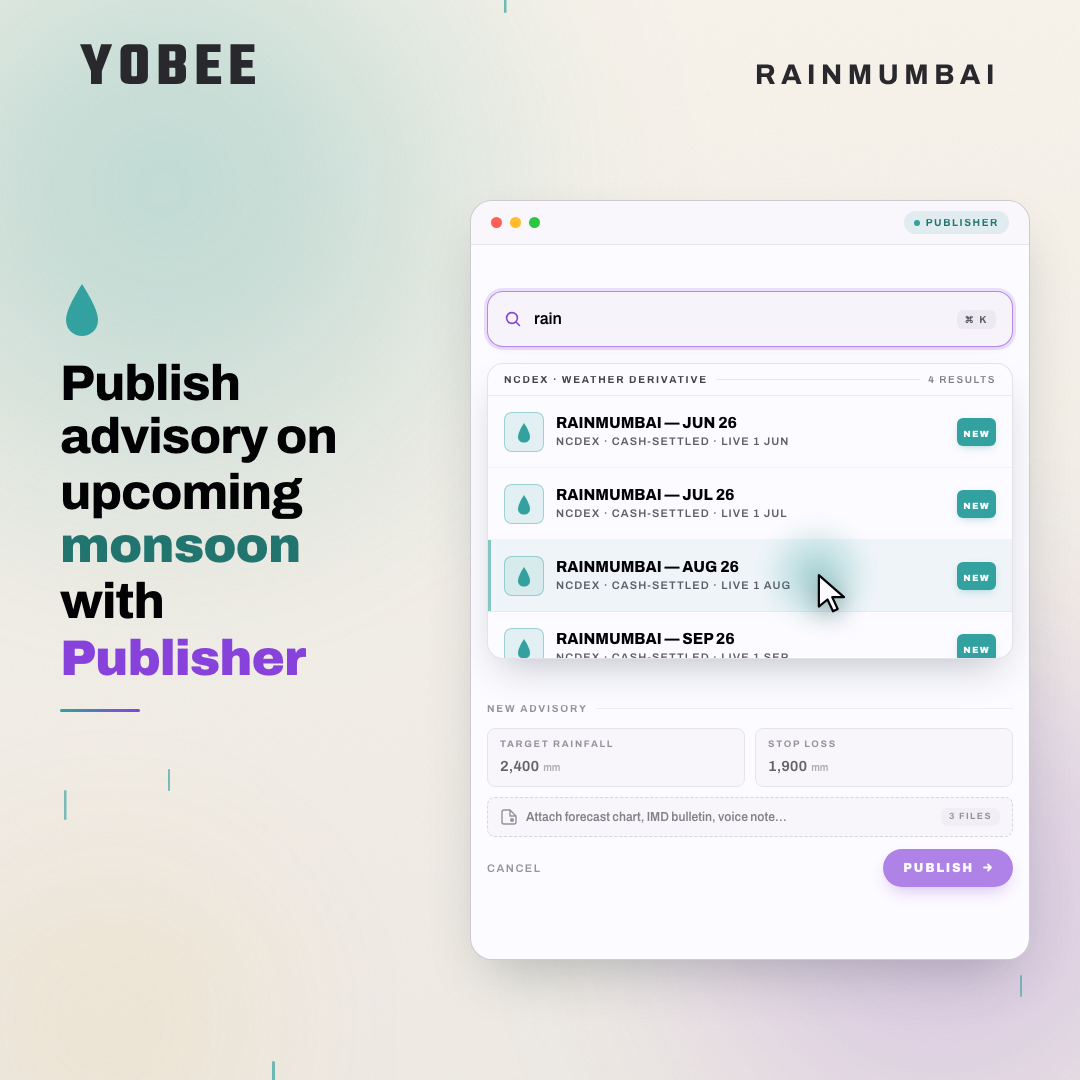
NCDEX opens India's first weather futures on 29 May, settled against Mumbai's 2,206.7 mm monsoon LPA
The National Commodity and Derivatives Exchange (NCDEX) begins trading on RAINMUMBAI, India's first exchange-traded weather derivative, on 29 May 2026. The contract is cash-settled and parametric, with settlement referenced to the cumulative deviation of Mumbai's June–September monsoon rainfall from a Long Period Average of 2,206.7 mm. SEBI approval is in hand. The product was developed with IIT Bombay and uses India Meteorological Department (IMD) data from the surface stations at Santacruz and Colaba.
The headline specifications from NCDEX circular NCDEX/TRADING-019/2026:
- Underlying: Cumulative Deviation Rainfall (CDR) for Mumbai against the 2,206.7 mm LPA
- Expiries: June, July, August and September 2026 (four monthly contracts)
- Tick size: 1 mm
- Lot multiplier: ₹50 per mm
- Maximum order: 50 lots
- Settlement: cash, against IMD daily prints from Santacruz and Colaba
- Trading window: Monday to Friday, 10:00 to 23:30 (extending to 23:55 in seasonal periods)
This is the first time a non-financial, non-commodity underlying sits inside the SEBI-regulated F&O framework in India.
Four monthly expiries, ₹50 a millimetre, Santacruz and Colaba as the print
Each contract is cash-settled at month-end against the cumulative rainfall deviation from the relevant Long Period Average. The underlying observation is the daily print from IMD's Santacruz and Colaba surface stations, both well-established reference points for Mumbai's monsoon record. No physical delivery, no warehouse leg, no quality discount.
The economics are sized for accessibility. A 1 mm tick at ₹50 per mm puts one tick on one lot at ₹50; the 50-lot maximum order caps single-order tick value at ₹2,500 per mm. Trading runs the full commodity day, 10:00 to 23:30, with a seasonal extension to 23:55.
The contract is parametric: settlement triggers off the measured index alone, with no damage assessment, claim filing or beneficiary verification. The structure is familiar from CME's heating-degree-day and cooling-degree-day contracts, which have run since 1999, and from domestic crop insurance schemes. It is new to the Indian exchange-traded universe.
Weather joins equity, debt and commodities on Indian multi-asset shelves
Three things change in practice for firms that cover multi-asset.
Asset-class taxonomy. The Indian exchange-traded universe has so far run on equities, debt, currencies and commodities. RAINMUMBAI sits outside all four. Multi-asset frameworks at brokers, research firms and AMCs will need a place for an instrument whose underlying is neither a security nor a physical commodity.
Coverage and research. There is no Indian precedent for sell-side or in-house research on rainfall as an underlying. Methodology for fair value, basis behaviour against IMD forecasts, and historical settlement comparison has to be built. The CDR construction and station-level rainfall history are new inputs for research desks.
Distribution and advisory surfaces. Broker terminals, advisory frameworks and product shelves are usually segmented by asset class. Where RAINMUMBAI sits, whether under commodities, structured products or a new weather sleeve, is a decision each firm has to take before client-facing desks can quote it.
The implication is that the Indian advisory stack is being asked, for the first time, to absorb an instrument whose price has nothing to do with company performance, interest rates or physical commodity supply.
September 2026 sets the first real read on weather-risk demand
Open interest and turnover across the four monthly expiries will be the first hard signal of whether weather risk has a buyer base in India. The September 2026 contract, covering the closing month of the south-west monsoon and the most exposed to forecast revisions, is the cleanest reference point for hedger and speculator participation.
The bigger question is what comes next. The 2,206.7 mm LPA applies to Mumbai. Nothing in the approval prevents NCDEX from extending the framework to other cities, to monsoon stages, or to other weather perils such as temperature. India has recorded roughly $180 billion in losses from extreme weather events over the past three decades. RAINMUMBAI is the first instrument; what gets listed beyond it is the next decision for the regulator and the exchange.