Capital markets explainers
NSE EGRs go live, adding a second digital-gold rail
27 May 2026 · Yobee Team
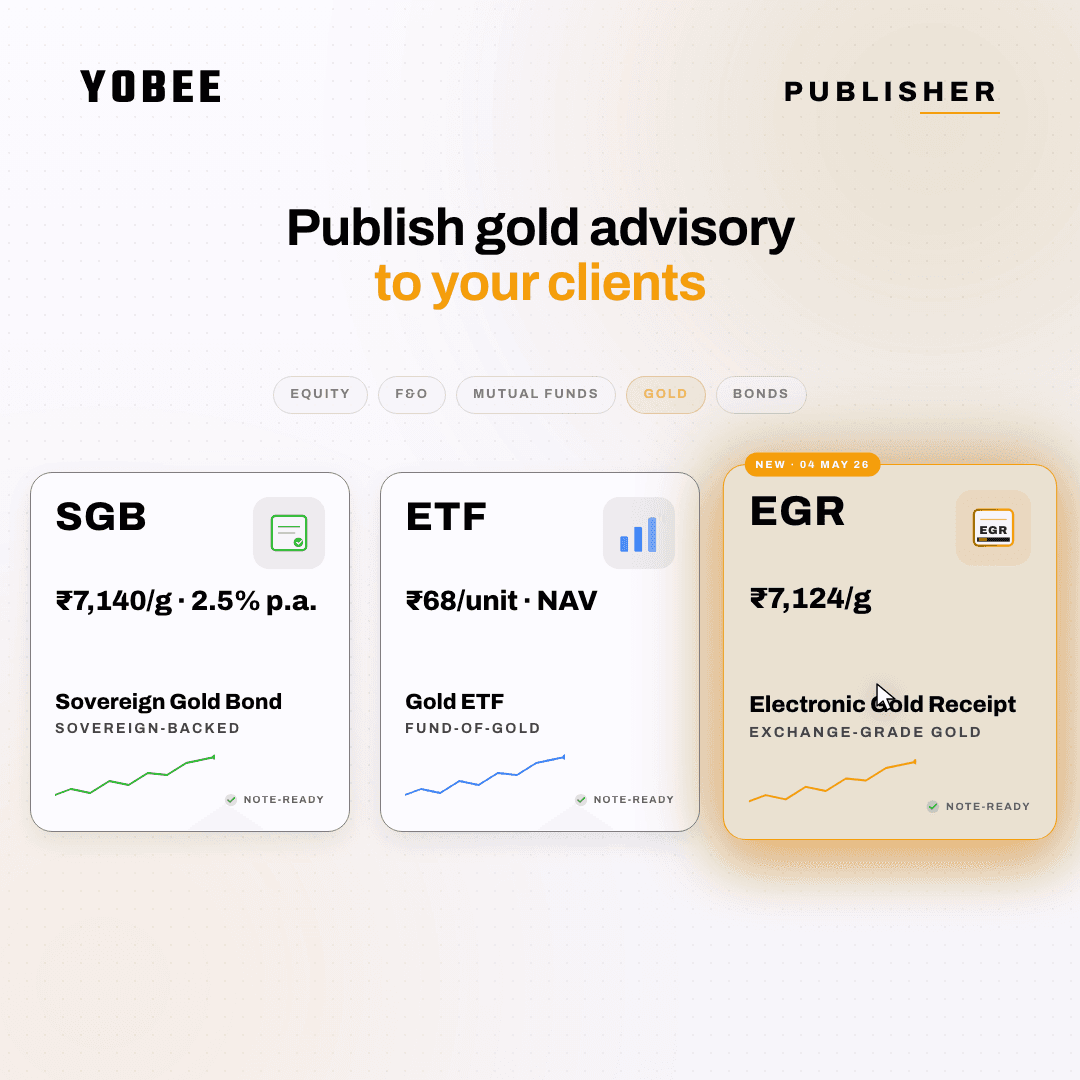
NSE turns on its EGR segment, three years after BSE
NSE launched its Electronic Gold Receipts (EGR) segment on 4 May 2026, per the exchange's press release dated 04 May 2026. EGRs are exchange-traded electronic instruments representing standardised, vault-held gold, convertible to and from physical gold through SEBI-registered vault managers. Trading runs Monday to Friday, 9:00 am to 11:30 pm, with T+1 settlement.
The segment goes live with two purity grades and five denominations:
| Symbol family | Denomination | Purity |
|---|---|---|
| GLD100MG99 / GLD100MG95 | 100 mg | 999 / 995 |
| GOLD1G99 / GOLD1G95 | 1 g | 999 / 995 |
| GOLD10G99 / GOLD10G95 | 10 g | 999 / 995 |
| GOLD100G99 / GOLD100G95 | 100 g | 999 / 995 |
| 1 kg contract | 1 kg | 999 / 995 |
The framework is the one SEBI set up across early 2022 (gold-exchange circular SEBI/HO/CDMRD/DMP/CIR/P/2022/07 of 10 January 2022, followed by circulars on trading features, product specifications, the risk management framework, and standard operating guidelines for vault managers and depositories through April 2022). BSE has been running EGRs on the same framework since Muhurat trading 2022. Two vault managers, Sequel Logistics and Brink's India, are SEBI-registered.
Why the NSE listing matters
EGR liquidity has so far sat almost entirely on BSE, where retail adoption has been thin. NSE handles the bulk of India's retail equity flow and is plugged into the demat and trading accounts of nearly every active retail investor in the country. Putting EGRs on the NSE shelf, alongside Gold ETFs in the same demat, is the change.
Three things follow.
- Distribution reach. Every NSE-linked broker now carries an EGR product line by default. A retail investor with an active NSE demat and trading account does not need to open anything new to access EGRs. That was not the case while EGRs were BSE-only.
- A second domestic-spot rail. EGRs price off the exchange order book. SEBI's parallel direction to align Gold ETF NAVs with domestic spot prices, effective 1 April 2026, means that two of India's three regulated digital-gold instruments, Gold ETFs and EGRs, now reference domestic exchange-derived spot rather than international benchmarks plus LBMA-derived adjustments.
- Physical convertibility on the same plumbing. An EGR holder can submit a withdrawal request to the depository, which routes to the vault manager; the EGRs are extinguished on delivery. Conversion attracts 3% GST. Conversion between physical and EGR has not been treated as a "transfer" for capital-gains purposes since the Union Budget 2023.
For full-service brokers and bank brokerages, this is a regulated multi-asset instrument added to a product universe that has been overwhelmingly equity-and-derivatives-led.
What firms will actually use it for
A few real surfaces, kept narrow.
- A new symbol set for research-management and recommendation systems to ingest: eight contract codes across two purity grades and four small denominations, plus the 1 kg series.
- An ETF-vs-EGR-vs-physical comparison surface for advisory teams covering retail and HNI gold allocations, on expense ratio (Gold ETFs carry a TER, EGRs do not), conversion mechanics, GST treatment, and settlement.
- A demat-resident gold position that can sit on the same broker statement as equity holdings, simplifying reporting for clients who already hold Gold ETFs and physical gold separately.
Yobee's research-management platform supports new exchange-listed instruments, including symbol mapping and recommendation linking, as part of its standard ingestion flow.
The market backdrop
The launch lands against a market that has been moving steadily into paper-format gold. Gold ETF AUM stood at around ₹1.81 lakh crore at end-January 2026 across roughly 1.2 crore folios, with combined gold and silver ETF inflows of ₹33,503 crore in January alone, the first month they outpaced net equity fund inflows. India's total gold demand was 710.9 tonnes in 2025, with investment demand (bars and coins) up 26% year-on-year in Q4 2025; the World Gold Council projects 600–700 tonnes for 2026.
The forward step worth tracking is volume on the NSE EGR segment over the next two to three quarters, particularly against BSE's existing EGR turnover. If the second listing meaningfully closes the liquidity gap with Gold ETFs, EGR coverage moves from optional to standard on the broker product shelf.