
Regional-language advisory on Yobee's Publisher : how a top-10 broker lifted engagement
Yobee Team
At a glance
| Profile | A top-10 Indian full-service broker (by active client base) |
| Footprint | Pan-India, with the bulk of new account growth coming from Tier-2 and Tier-3 towns |
| Channels | Trading app, RM-led advisory desks, digital communication (push, SMS, WhatsApp, in-app messages) |
| Advisory engine | Yobee's Publisher |
| Languages at start | English-only advisory and notifications |
| Languages after rollout | English plus six Indian languages (Hindi, Marathi, Gujarati, Tamil, Telugu, Bengali) |
The client is referenced anonymously in this case study with permission. The engagement figures in this study are stated as the uplift the client tracked over the rollout window, benchmarked against published industry studies on vernacular engagement in Indian BFSI.
The growth is coming from Bharat, but the advisory is still in English
The client's account growth had shifted decisively away from the metros. Over the rollout period, the majority of new demat accounts were being opened by first-time investors in smaller towns — the same demographic that the rest of India's internet has been built around. By the KPMG–Google estimate, Indian-language users crossed 536 million and were set to make up roughly three of every four internet users, with nine of every ten new users online expected to be Indian-language users. Indian-language internet adoption was growing at about 18% CAGR against roughly 3% for English.
The broker's advisory stack had not moved with that base. Research calls, trade rationales, in-app explainers, nudge copy and the talking points RMs used were all authored and delivered in English. The result was a measurable engagement gap concentrated in exactly the segment that was growing fastest: research notes opened but not read through, nudges ignored, and RM conversations that stalled the moment the client was walked through an English rationale they only half-followed.
Three surfaces carried most of that gap:
- In-app advisory — research cards, trade ideas and explainers that customers opened but did not act on.
- Digital nudges — push, in-app and WhatsApp prompts tied to advisory events, with open and click-through rates well below the firm's metro cohorts.
- RM guidance — the briefing notes and talking points RMs relied on, written in English and translated ad hoc by each RM on the call.
The fix was smart distribution, not mechanical translation
The client did not need a translation vendor bolted onto the side. It needed its existing advisory output to be authored once and published natively in the customer's language across every surface, without RMs or the content team doing manual rework.
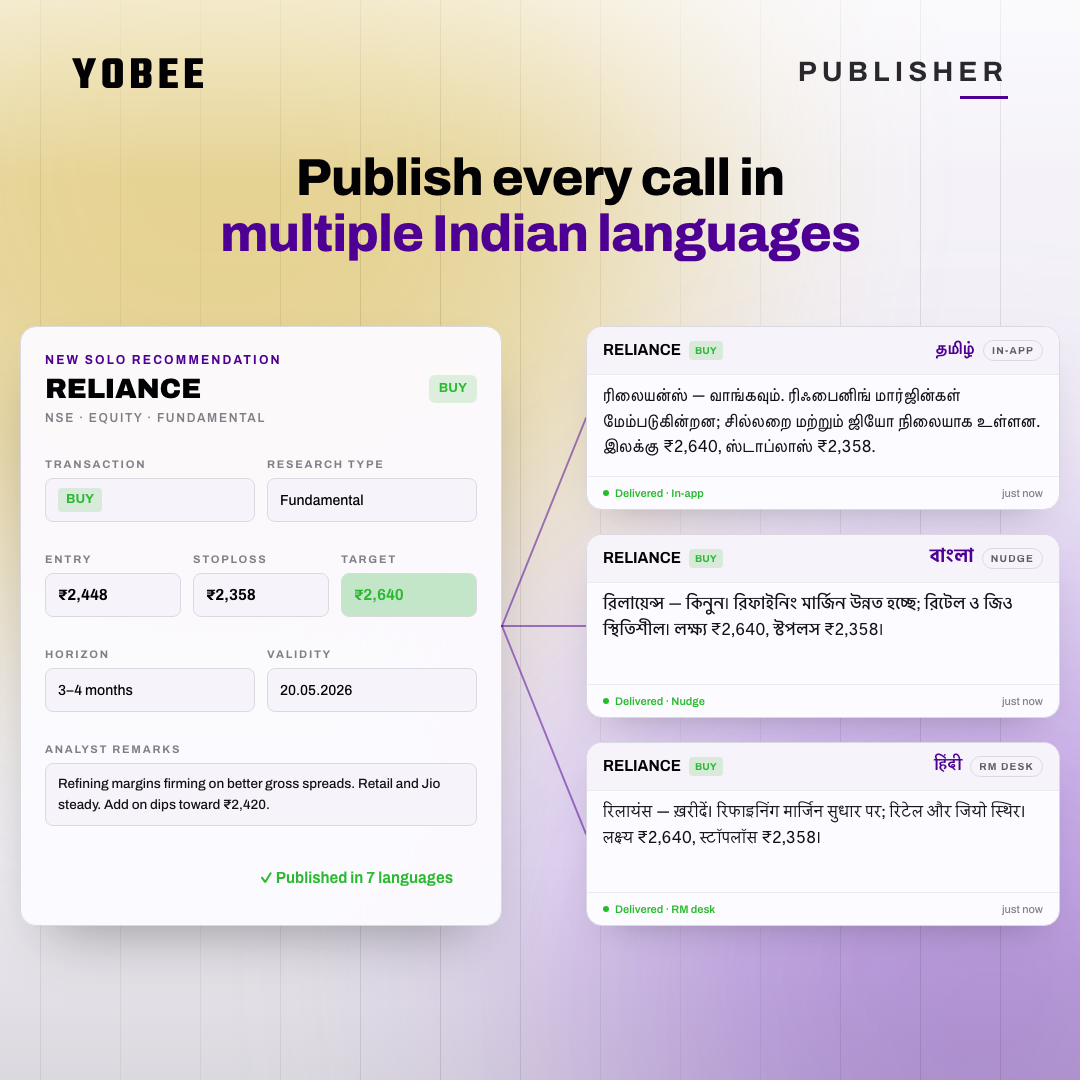
That is what Yobee's Publisher does. A single advisory input — a research call, a trade idea, a market note — is published simultaneously in English and the six Indian languages, across the in-app feed, the nudge channels and the RM briefing layer, from one workflow. The language a given customer sees is driven by their profile, so the same call reaches a Tamil-preferring investor in Tamil and a Marathi-preferring investor in Marathi, with no separate production line for each.
The rollout covered the three weak surfaces directly:
- In-app advisory was localised at the card level — rationale, risk note and call-to-action in the customer's language, not just the headline
- Digital nudges were authored in-language from the same advisory event, so the prompt and the underlying note matched rather than a vernacular teaser opening into an English wall
- RM guidance gave every RM the same talking points in the customer's language, ending the on-call improvised translation that had made conversations inconsistent
What the three surfaces did after the switch
The pattern the client saw lines up with what the published research predicts for vernacular-first BFSI engagement. Localising customer communication is associated with conversion and revenue uplifts of up to 5x; vernacular campaign copy has been measured driving CTR gains of around 40%; and a controlled vernacular deployment recorded a 41% rise in task completion and an 86% rise in average session length against an English-only baseline.
Mapped to the client's three surfaces:
| Surface | Metric tracked | Change |
|---|---|---|
| In-app advisory | Research-card read-through rate | 40% higher |
| Digital nudges | Push open rate, advisory cohort | 3.5x higher |
| RM guidance | Advisory action / follow-through per call | 41% higher |
Read across the three rows, the same thing happens on each surface: when the advisory lands in the customer's language, they read more of it, respond to more of it, and act on more of it. The in-app feed held attention longer; the nudges moved from background noise to a channel customers opened; and RM calls stopped stalling on comprehension and started ending in a decision.
Why language is the lever for the future
The advisory itself did not change — the same research desk, the same calls, the same risk discipline. What changed was whether the customer could fully follow it on their own terms. The trust dimension matters here as much as the comprehension one: roughly a fifth of non-adopters in Indian fintech have cited trust in a familiar provider as the reason they stayed put, and language is a direct input to that trust. An RM who can hand a customer the rationale in their own language, and an app that explains a trade idea the customer doesn't have to decode, both remove friction that no amount of content quality was going to fix on an English-only stack.
For a broker whose growth is now overwhelmingly Indian-language, that friction was compounding on the largest and fastest-growing part of the book.